
Step off the plane at JFK in late July and the air hits you like a warm, wet towel someone’s draped over your face as a personal favour. It’s 30 degrees. The humidity is 74%. There is moisture in this air that you could wring out. Your phone’s weather app is showing a cheerful little sun, which is technically accurate in the same way “fresh” is technically accurate for a Wearside seafront in January — correct on paper, wildly misleading in practice.
If you’ve spent your whole life wearing a T-shirt in October and wondering what everyone’s fussing about with coats, New York in July is the universe’s way of getting its own back. You will sweat through something within twenty minutes of leaving the terminal. This is not a character flaw. This is just July in New York, and eight million people deal with it every day by walking fast, not making eye contact, and using the subway the moment any reasonable alternative presents itself.
There’s a song about being stubbornly yourself in a city that doesn’t particularly care — written, as it happens, by a man from Wallsend. Sting’s point was about holding your identity in an overwhelming place. Thousands of Mackems descending on Harrison, New Jersey in red and white stripes, singing an Elvis song, in 30-degree heat that none of them were prepared for, is exactly that energy. The North East’s most famous musical export — depending entirely on who you ask, and you know what answer to give — accidentally wrote the anthem for this trip.
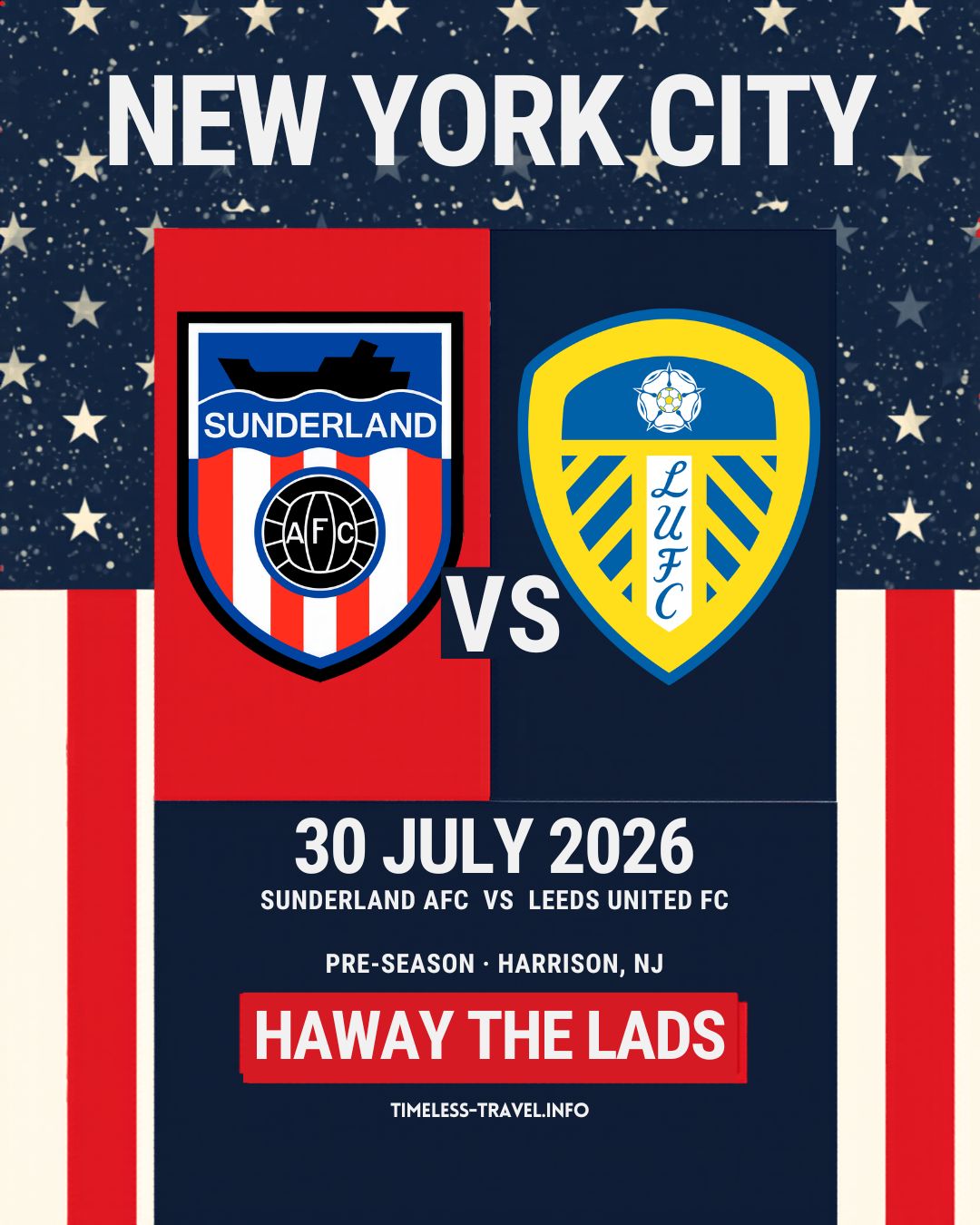
Sunderland play Leeds on 30 July. First US tour as a Premier League club. Eight years in the making. Here’s your guide to not wasting the rest of it.
The Thing Nobody Bothers to Find
Grand Central Terminal has been photographed approximately six hundred million times. Everyone gets the celestial ceiling, the shafts of light, the famous clock — you’ve seen it in The Avengers, Revolutionary Road, that scene in The Terminal where Tom Hanks looks confused (admittedly his default setting). Tourist photographs clock. Tourist leaves. Tourist misses the actual good bit.
Go downstairs instead. Head past the main concourse toward the Oyster Bar. Just outside the entrance, four tiled arches meet at a corner. Stand in one, face the wall, and whisper. The person standing diagonally opposite — about twelve metres away — will hear you as clearly as if you were talking directly into their ear.
This is the Whispering Gallery. A Valencian architect called Rafael Guastavino arrived in New York in 1881 and spent the next few decades building domed tile ceilings all over America — over a thousand of them, including the Brooklyn Bridge undercroft and Ellis Island’s Great Hall. The whispering effect at Grand Central was a complete accident. The ceramic tiles carry sound along the curve with almost no loss, which is the sort of thing that sounds like nonsense until you’re standing in a corner of a Manhattan train station listening to a stranger twelve metres away debate what to have for lunch.
Completely free. No booking. No queue. In a city where going upstairs at the Empire State Building costs $79 and wandering around the Met costs $30, a free accidental acoustic marvel is practically an insult to the local economy.
Right, So About the Match
The game’s in Harrison, New Jersey. Not New York City. Worth being upfront about rather than quietly hoping you wouldn’t notice on the map. Sports Illustrated Stadium is seven miles west of Manhattan, on the bank of the Passaic River — excellent ground, holds 25,000, sixth-largest football-specific stadium in the USA. Just also very much in New Jersey.
Getting there is dead easy. PATH train from World Trade Center or 33rd Street, twenty-two minutes, $3. That’s about £2.40 — cheaper than a single on the Metro back home, and nobody’s tried to close this line for engineering works since 2019. Seven-minute walk from Harrison station to the ground. Cashless only throughout, so make sure your phone’s charged before you leave.
Bonus fixture for anyone doing the full tour: Liverpool play Wrexham at Yankee Stadium the evening before, 29 July, the Bronx. That’s roughly 35 minutes from Harrison. Two matches on consecutive nights with all of Manhattan in between — either very efficient planning or the beginning of a story you’ll still be telling in 2031.
What To Do (And When the Heat Will Let You)
Here’s the honest version of how New York in July works. Before noon it’s hot but manageable. After noon it’s a different situation entirely — the pavement is radiating heat upward, the humidity has achieved something almost physical, and anyone suggesting a “nice walk” needs to be spoken to firmly. Structure your days around this and you’ll have a brilliant time. Ignore it and you’ll spend an afternoon on the High Line looking like you’ve been hosed down.
Before noon: get outside
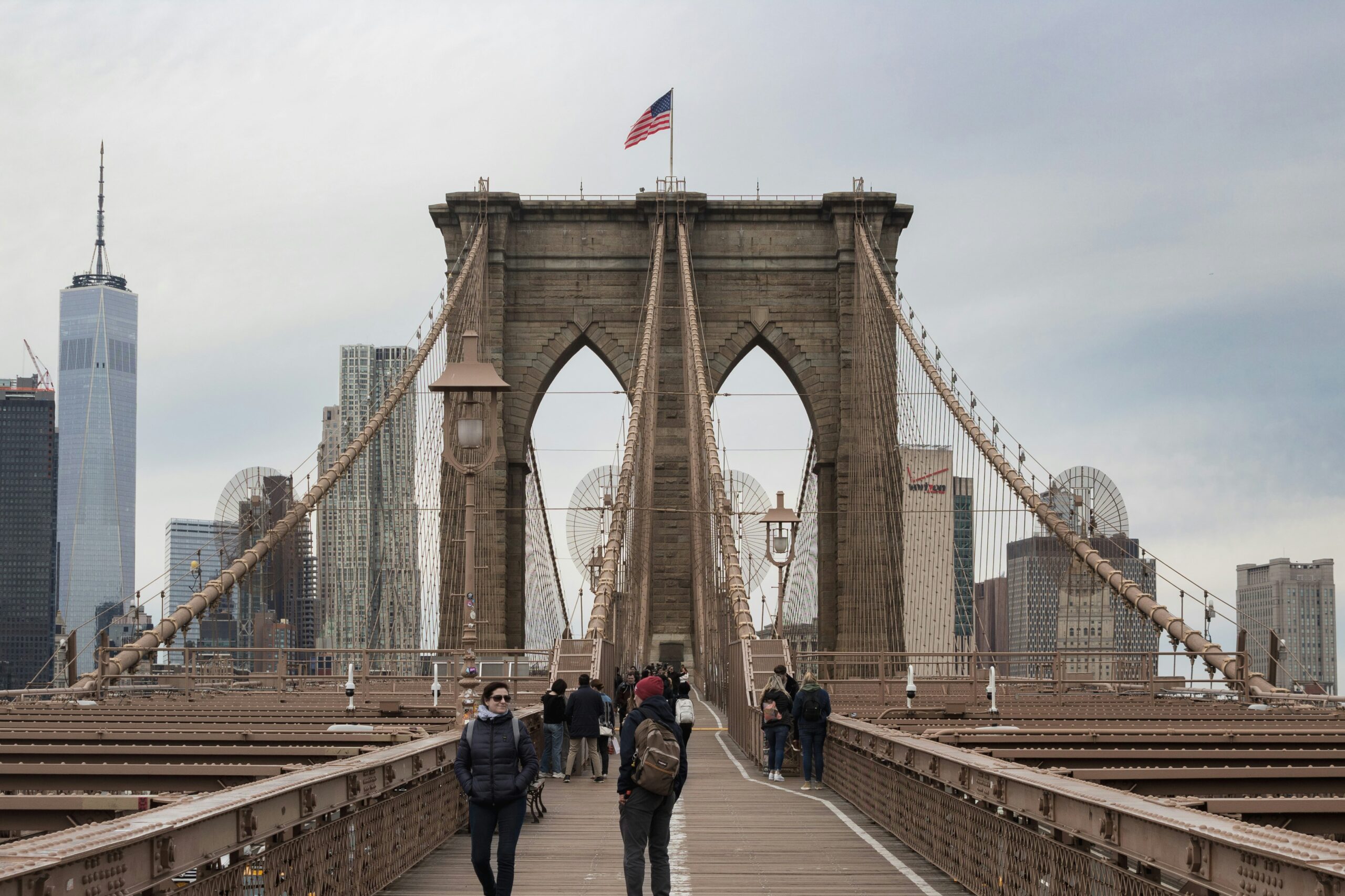
The Brooklyn Bridge is free and takes about half an hour to walk. Cross from Brooklyn toward Manhattan — that’s the skyline view worth having. Go before nine. By eleven the pedestrian walkway is full of cyclists, tripods, and people who’ve never considered that other pedestrians might also want to use the bridge.
Central Park is free and enormous — 341 hectares, America’s first proper landscaped public park, opened 1858, still the benchmark everything else gets measured against. Hire a bike ($12–$25 for the day, about £9.60–£20, helmet and lock included) and get round it early. By mid-afternoon it’s a beautiful, sweltering outdoor event that smells of sunscreen and quiet personal regret. Both versions of the park exist. One of them is considerably easier on your shirt.
Afternoon: find somewhere air-conditioned and call it culture
This is genuinely New York’s gift to the summer visitor. The city is full of world-class things to do inside, and in July the air conditioning alone justifies the entrance fee.
The Met — the Metropolitan Museum of Art — costs $30 (£24) for anyone not from New York State. Mandatory, not optional, since they removed the pay-what-you-wish deal for out-of-towners. Three million objects, kept at the temperature of a pleasant English autumn. Go in with no plan and you’ll find something extraordinary within twenty minutes. Go in with a plan and you’ll exhaust yourself trying to tick things off a list. The first approach is correct.
MoMA is $25 (£20). Free on Friday evenings from 5pm. If your trip falls on a Friday, this is the smartest £20 you won’t spend. Picasso, Warhol, Pollock, and a Van Gogh Starry Night that looks genuinely different in person — bigger, darker, and more restless than any poster version you’ve ever seen.
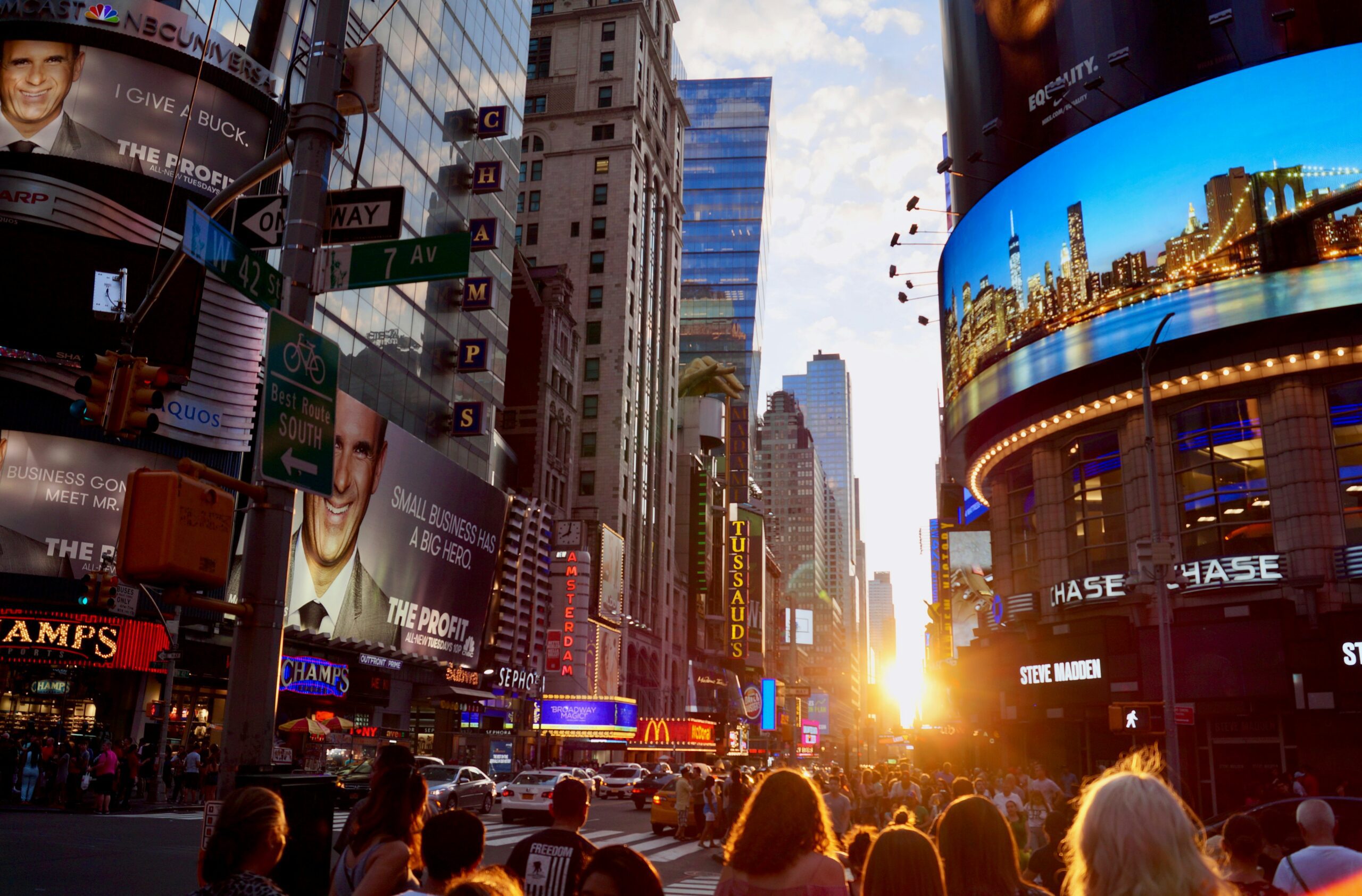
Broadway is the other big one, and most people put it off and then wish they hadn’t. Shows run daily — matinees from around 2pm, evening shows from 7 or 8. The TKTS booth in Times Square sells same-day discount tickets, usually 20–50% off. Sitting in a darkened, aggressively air-conditioned theatre for two and a half hours watching something that cost forty million dollars to put together is, in July, both a cultural experience and a survival strategy. You’ll be fine with either justification.
Film and TV location tours deserve a proper mention because they’re better than they have any right to be. On Location Tours run dedicated routes covering Sex and the City, Seinfeld, Gossip Girl, and general NYC filming locations — two to three hours, around $49–$65 per person (about £39–£52). You spend it on a bus with commentary, pointing at things you recognise from the telly, which sounds like something you’d never do and turns out to be genuinely fun.
Sex and the City is worth a few stops on its own. 66 Perry Street in Greenwich Village is Carrie Bradshaw’s brownstone — quick photo, move on, it’s a private residence and the people who live there have been dealing with tourists since 2003 with extraordinary patience. Magnolia Bakery on Bleecker Street appeared in one episode and has been dining out on it ever since. The banana pudding is legitimately good. The queue is annoying. Worth it if you’re already in the neighbourhood; not worth crossing town for.
Katz’s Delicatessen on East Houston Street has been open since 1888 and appears in When Harry Met Sally — there is a sign above the exact table. You know the scene. The pastrami sandwich costs $28 (about £22), weighs roughly a pound, and will solve the question of dinner without further discussion.
The Friends building is 90 Bedford Street in Greenwich Village — the exterior used as the establishing shot for all ten series. Worth a photo. The café inside is a real restaurant now called The Little Owl. Worth a coffee. Genuinely not worth a forty-minute queue, which people somehow do.
Hook & Ladder 8 in Tribeca — 14 North Moore Street — is the Ghostbusters fire station. Still an active firehouse. The Ghostbusters sign is outside. The firefighters have seen every possible human reaction to this and are magnificently unbothered by all of it.
Evening: the High Line finally makes sense
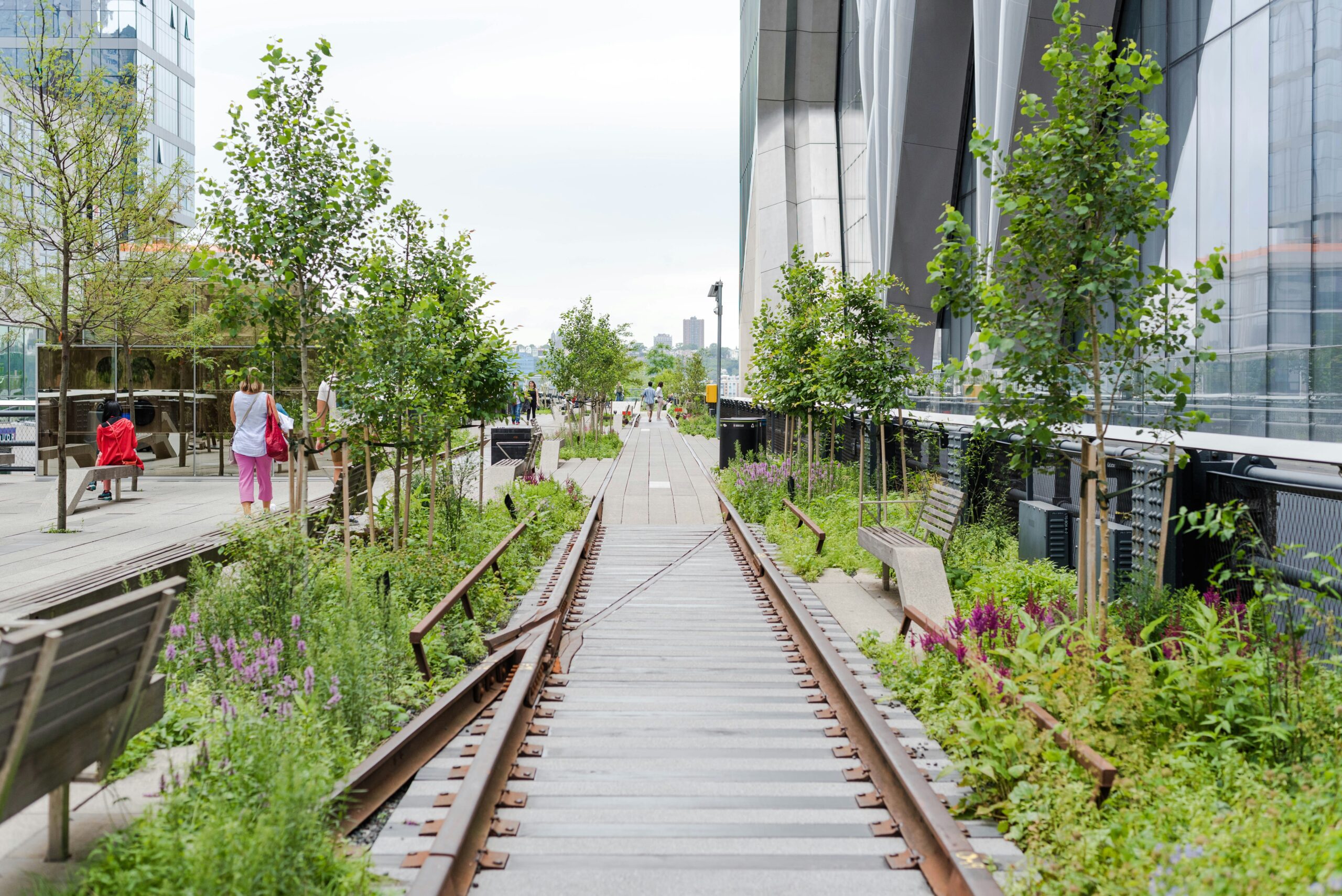
The High Line is a 2.3km elevated former railway track converted into a public walkway through Chelsea. At noon in July it is an exposed sun trap with no shade and very good views. At 7pm, when the temperature drops and the light goes golden over the Hudson, it becomes one of the best free walks in the city. Enter at Gansevoort Street and head north. The stretch between 30th and 34th Street, looking toward Midtown, is the one that makes you understand why people move here and then never leave despite everything.
Food
New York pizza costs $3.50 a slice now. That’s about £2.80 — still less than a Greggs steak bake, and yes, that comparison is carrying significant weight. Joe’s Pizza in Greenwich Village is the standard everyone measures against. Prince Street Pizza in Nolita does a Sicilian square that has developed a cult following slightly out of proportion to the size of the room.
Bagels: Russ & Daughters, Houston Street, open since 1914. Lox, cream cheese, queue before opening. New Yorkers will tell you it’s the water. It’s partly the water, mostly the boiling before baking, and entirely the century of practice. Nod, agree, eat the bagel.
Budget $75–$125 a day (£60–£100) for food and drink at a reasonable pace. A cold beer in a bar runs $6–$12 (£4.80–£9.60). After an afternoon in the heat, that first cold beer earns every single penny of it.
Tipping is 18–20% at sit-down restaurants, $1–$2 per drink at the bar. Wages are built around it. Not optional.
Getting There and Getting Round
Flights: Direct from Heathrow and Gatwick to JFK with Virgin Atlantic, BA, American, and United — around eight hours. Manchester has direct service with Virgin Atlantic and Aer Lingus. From Newcastle you’ll need a connection via Heathrow, Dublin, or a US hub.
JFK to Manhattan: Subway (AirTrain + A train) is $11.40 (£9.10), takes 60–90 minutes, fine if your bags are manageable. Flat-rate taxi is $70 plus tolls and tip — roughly £60 total — and takes 45–90 minutes in July traffic, which is anyone’s guess. Newark is often faster into Manhattan: NJ Transit and AirTrain, about $15 (£12), 45–60 minutes, and handily closer to Harrison for the match.
Around the city: Subway, $3 per tap via OMNY contactless — your UK bank card works fine, MetroCard was scrapped on 1 January 2026. A rolling 7-day cap of $35 (£28) kicks in automatically after about 12 journeys. The subway is air-conditioned. In late July this is not a small detail — it is the primary reason to take it even for short distances.
To the match: PATH from World Trade Center or 33rd Street to Harrison, 22 minutes, $3. Seven-minute walk. Cashless throughout.
Plan Your Trip
New York’s guided tours are genuinely excellent — Statue of Liberty with crown access, Central Park cycling, Brooklyn food walks, Broadway packages, and those film location tours. Browse New York experiences on Viator or check out GetYourGuide’s NYC listings — both are strong for skip-the-queue access to the big attractions, which in July is less a convenience and more a basic requirement for enjoying yourself.
Book through our links and we get a small commission. It keeps the site going. Someone’s got to pay for that $9 beer.
See You in Harrison
Sunderland are expected to bring somewhere between 2,500 and 5,000 fans to a pre-season game in New Jersey on a Tuesday evening in the middle of a heatwave. That’s either one of the most impressive displays of loyalty in world football, or a collective inability to say no to an adventure. Almost certainly both.
The song will start before kick-off. On the bank of the Passaic River, inside a stadium named after a sports magazine, the city that partially inspired Sting to write about being stubbornly yourself somewhere overwhelming — visible just across the water.
Completely incongruous. Absolutely right. Very Sunderland.
Do the Whispering Gallery. Eat the pastrami. See the show. Sweat through something. Come home with a story.
Haway the lads. 🔴⚪
Done Nashville already? Our Sunderland in Nashville travel guide covers the first leg.
Leave a Reply