
Two sculptors had already given up on the block of marble. That’s the bit most Florence guides skip. When the twenty-six-year-old Michelangelo won the commission to carve a David for Florence Cathedral in 1501, what he actually inherited was a piece of Carrara marble that had been sitting in a work yard for twenty-five years, rained on, roughed out badly by two previous artists who’d both essentially said: not happening. Too narrow. Too shallow. Too far gone.
Three years later, the finished statue stood 5.17 metres tall. A committee that included Leonardo da Vinci and Botticelli took one look at the thing and decided it was too good for the cathedral roofline it had been designed for. They put it in the main square instead. Only in Florence does a rejected bit of stone end up becoming the most famous sculpture on Earth. The whole city runs on that kind of energy.
Florence renaissance art isn’t something you tick off a museum checklist. It’s a story you walk through — and the main characters are a banking family with an immortality complex, a dome nobody thought was possible, and one very stubborn twenty-six-year-old.
The Bankers Who Bought Immortality
The Medici weren’t artists. They were bankers. Think less “passionate art collectors” and more “Renaissance-era private equity, but with better taste in sculpture.”
Cosimo the Elder kicked things off in the 1430s. He bankrolled Brunelleschi’s cathedral dome — a project so ambitious that nobody actually knew how to build it, and Brunelleschi had to basically invent the engineering live on-site, which is either visionary or terrifying depending on your tolerance for improvisation. Cosimo also funded Donatello, built Florence’s first public library, and ran the city for thirty years without ever holding an official title. Unofficial dictator with excellent taste. Florence seems to attract those.
His grandson Lorenzo the Magnificent was worse, if you define “worse” as “even more extravagant.” Lorenzo was a poet, a diplomat, and fundamentally a talent scout who couldn’t stop adopting geniuses. He filled a sculpture garden with ancient statuary and let anyone interesting hang around studying it. Botticelli came. Leonardo da Vinci came. And a teenage Michelangelo more or less moved in, growing up in the Medici household like a favoured nephew who happened to be supernaturally good with a chisel. It’s giving wealthy Renaissance uncle who keeps inviting interesting people for dinner and then funding their careers — except the dinner lasted an entire generation and the careers reshaped Western art.
The result: within a few city blocks, Florence produced the largest dome ever built, the bronze “Gates of Paradise” for the Baptistery, The Birth of Venus, and the David. The Medici paid for nearly all of it. Their name is on the chapels, the libraries, the tombs. Six centuries of brand visibility. The marketing department at Apple could never.
Why It Still Earns the Queue
Plenty of European cities trade on history. Florence’s advantage is density. The entire centro storico is a UNESCO World Heritage Site, and it’s compact enough that you can walk from the Duomo to the Ponte Vecchio in ten minutes, passing more Renaissance architecture than most countries contain in their entirety. If Paris whispers through time, Florence raises its voice and doesn’t apologise for it.
The skyline is dominated by Brunelleschi’s dome: 45.5 metres across, over four million bricks, 25,000 tonnes of masonry. Still the largest masonry vault ever built, nearly six hundred years later, which is genuinely absurd when you think about it. The clever bit was a herringbone brick pattern that made the structure self-supporting during construction — no wooden scaffolding, which everybody at the time assumed was physically impossible. Climbing the 463 steps to the top (Brunelleschi Pass, €30, timed-slot booking mandatory — book ahead or don’t bother showing up) is worth it less for the panorama and more for the moment halfway up when you’re walking between the inner and outer shells and you realise just how thin the whole thing is. It’s the architectural equivalent of finding out a building that looks solid from outside is actually held together by engineering and audacity. Kevin McCloud would have a field day.
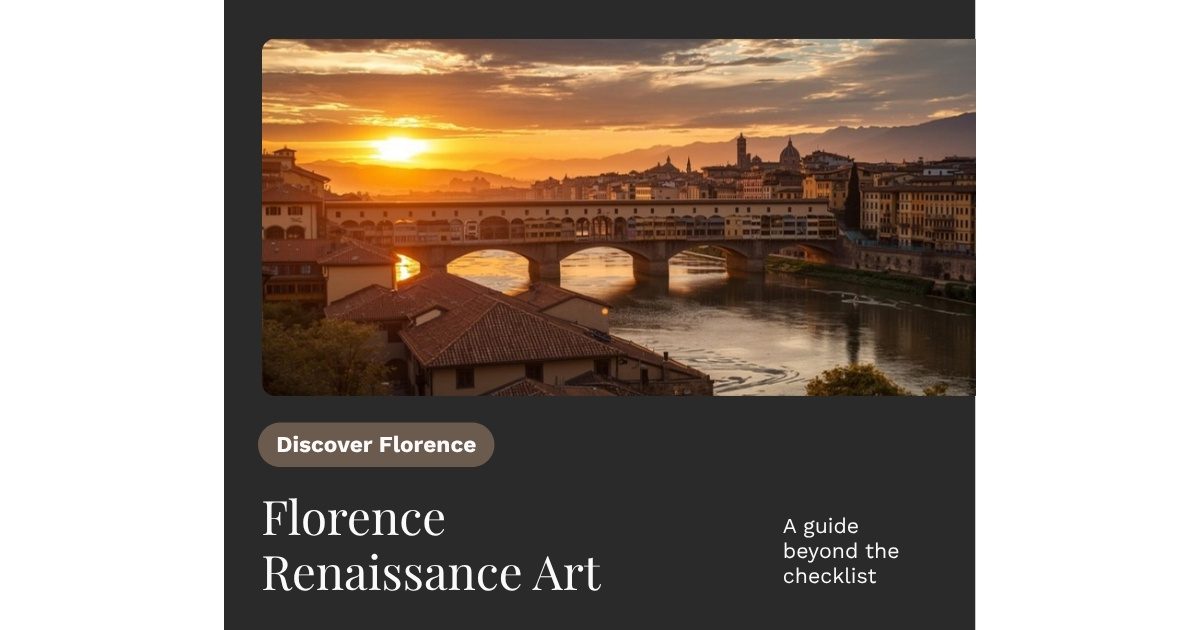
Below the dome, the city reads like a timeline you can walk along. Romanesque Baptistery (eleventh century), Gothic Santa Croce (thirteenth), the Renaissance dome itself (1420–1436), then the Mannerist Uffizi corridor (1560s). The colour palette is warm ochre and terracotta — the kind of skyline that looks best from Piazzale Michelangelo at sunset with a glass of something cold, feeling briefly like you’re in a Richard Curtis film before someone tries to sell you a selfie stick.
Standing Underneath the David (and Everything Else)
Start at the Galleria dell’Accademia (Tuesday–Sunday 08:15–18:50, €13 plus €4 booking fee — book ahead, always). The approach is deliberate and slightly theatrical. You walk a long corridor past Michelangelo’s unfinished Prisoners — figures half-emerging from rough marble, still trapped in the stone, looking like they’re trying to escape a particularly difficult Monday — and then the corridor opens and the David is just there. Lit from above by a skylight designed specifically for it.
If you want context before you walk in, a guided tour of the Accademia is worth every cent — a good guide turns Michelangelo’s unfinished Prisoners from curiosity into revelation, and makes the David feel earned rather than stumbled upon. Browse guided Accademia tours on Viator →
Here’s what nobody prepares you for: scale. You’ve seen the postcards. You’ve seen the fridge magnets. You think you know. You don’t. At 5.17 metres the proportions are subtly wrong — the hands are too large, the head oversized — because Michelangelo designed it for a cathedral roofline you’d be looking up at from sixty metres below. Seen at ground level, those deliberate distortions give the thing an uncanny sense of being alive. Visitors have been known to experience what the Italians call Stendhal Syndrome — dizziness and a racing heartbeat from being overwhelmed by the art. It sounds like something a dramatic Italian made up until you’re standing underneath it. The heart-shaped pupils are visible from certain angles, which feels like the kind of detail Michelangelo added purely to reward people who got close enough to notice.
The Uffizi (Tuesday–Sunday 08:15–18:30, €25 full price — personalised tickets now, so your name and date of birth must match your ID, which is a very Italian combination of bureaucracy and beauty) holds the Medici’s private collection: Botticelli’s Birth of Venus and Primavera, Caravaggio, Raphael, Titian. The building itself started life as government offices — “uffizi” literally means “offices” — which is the most Florentine origin story imaginable. Imagine if HMRC moved out and someone filled it with Raphaels. After 16:00, entry drops to €16 and the crowds thin noticeably. That late-afternoon slot is the one.
Don’t skip the Vasari Corridor, which reopened in late 2024 after eight years of closure. This is the elevated walkway Cosimo I built in 1565 so he could walk from Palazzo Vecchio to Palazzo Pitti without setting foot on the street. The route goes directly above the Ponte Vecchio, which at the time was home to butchers and tanners. Cosimo’s successor Ferdinando I, apparently unable to take the smell wafting up into his private corridor any longer, kicked the butchers out in 1593 and replaced them with goldsmiths. The forty-odd jewellery shops still on the bridge today exist because one Medici prince had a sensitive nose. Five centuries of goldsmithing tradition, started by one man’s low tolerance for offal. Visits are combined with Uffizi tickets (€20–24), groups of 25, about 35 minutes.
The Medici Chapels (Monday, Wednesday–Sunday 08:15–18:50, €9) house Michelangelo’s sculptural work on the Medici tombs — brooding figures of Dawn, Dusk, Day, and Night that manage to look simultaneously ancient and like they were carved last week. There’s also a secret room beneath the chapel where Michelangelo reportedly hid for two months in 1530 during a political crisis. Visits are by reservation only, limited to four people at a time.
Lampredotto, Bistecca, and a Table at Mario’s
Florentine food is Tuscan food without apology — peasant cooking built on bread, meat, and olive oil, refined over centuries into something that manages to be both humble and magnificent at the same time.
The centrepiece is bistecca alla fiorentina: a massive T-bone from Chianina cattle, grilled over wood, served rare, and charged by the kilogramme (€45–60/kg, enough for two). Ordering it well done is considered a minor act of hostility. Most trattorias will do it if you insist, but the waiter’s face will tell you everything you need to know about how they feel about it.
The street food you need to try — and I mean this, don’t chicken out — is lampredotto: the fourth stomach lining of a cow, slow-boiled in tomato broth, sliced into a bread roll, and topped with salsa verde and chilli oil. It costs €4–6 from the trippaio carts scattered around the centre. Yes, it’s stomach. Yes, it’s served from a cart. Yes, it is genuinely delicious. Nerbone inside Mercato Centrale has been serving it since 1872, which means it has survived two world wars, multiple recessions, and the invention of the panini. I’d call that a strong endorsement.
Mercato Centrale itself is worth an hour: the ground floor is the working food market (produce, butchers, cheese, mornings only), while the upper floor is a modern food hall open until midnight — basically an Italian Eataly before Eataly existed. For lunch, Trattoria Mario near San Lorenzo has been doing ribollita, pappa al pomodoro, and honest bistecca since 1953. Shared tables, no reservations, cash only. The wine is Chianti Classico. It’s always Chianti Classico.
Getting There and Getting Around
Florence Airport (Amerigo Vespucci) is 4km from the centre. The T2 tram runs every four to five minutes during peak hours, takes twenty minutes, and costs €1.50 — making the €22 taxi feel like a poor financial decision and a questionable life choice. From Rome, high-speed trains take 1 hour 20 minutes and start around €15 if you book ahead with Italo or Trenitalia. That’s faster and cheaper than most commutes in the South East, which is either a compliment to Italian rail or an indictment of Southern Rail, depending on your perspective.
The historic centre is compact. Every site in this post is within a twenty-minute walk of Santa Maria Novella station, so you genuinely don’t need transport once you arrive — just comfortable shoes and a willingness to get lost in streets that all look beautiful and none of which make navigational sense. Late September through October is the sweet spot: warm enough for walking, thin enough crowds that you can see the art without someone’s phone in your eyeline, and low enough prices to justify an extra night. July and August hit 35°C with queues to match. The first Sunday of each month offers free entry at the Uffizi, Accademia, and Palazzo Pitti — but everyone knows this, so arrive before 08:00 or resign yourself to a two-hour wait with increasingly optimistic street vendors.
Plan Your Trip
Florence rewards those who go deeper than the queue. A skip-the-line ticket at the Uffizi or a guided walk through the Medici’s Florence adds the kind of context that transforms a gallery visit from ticking off paintings to understanding why those paintings exist and who paid for them — which, in Florence, is usually the more interesting story.
Browse Florence tours and experiences on Viator or explore Florence activities on GetYourGuide.
We may earn a small commission if you book through our links, at no extra cost to you.
The Thing About the Marble
There’s a moment in the Accademia when you stop looking at the David as a statue and start thinking about the stone. The narrow block. The rough cuts from the 1460s that couldn’t be undone. The twenty-five years of rain while it sat abandoned because nobody knew what to do with it. Michelangelo turned every limitation into a feature — the shallow profile, the slight leftward lean, the proportions designed for a viewing angle that was never used.
A twenty-six-year-old looked at a piece of marble that two experienced professionals had abandoned and thought: I can see what’s in there. Six hundred years later, about four thousand people a day queue up to find out what he saw. Most of them leave understanding why the committee was right. It was too good for the roof.
Leave a Reply